New Talent Strengthens the DigitalCNC Engineering Team
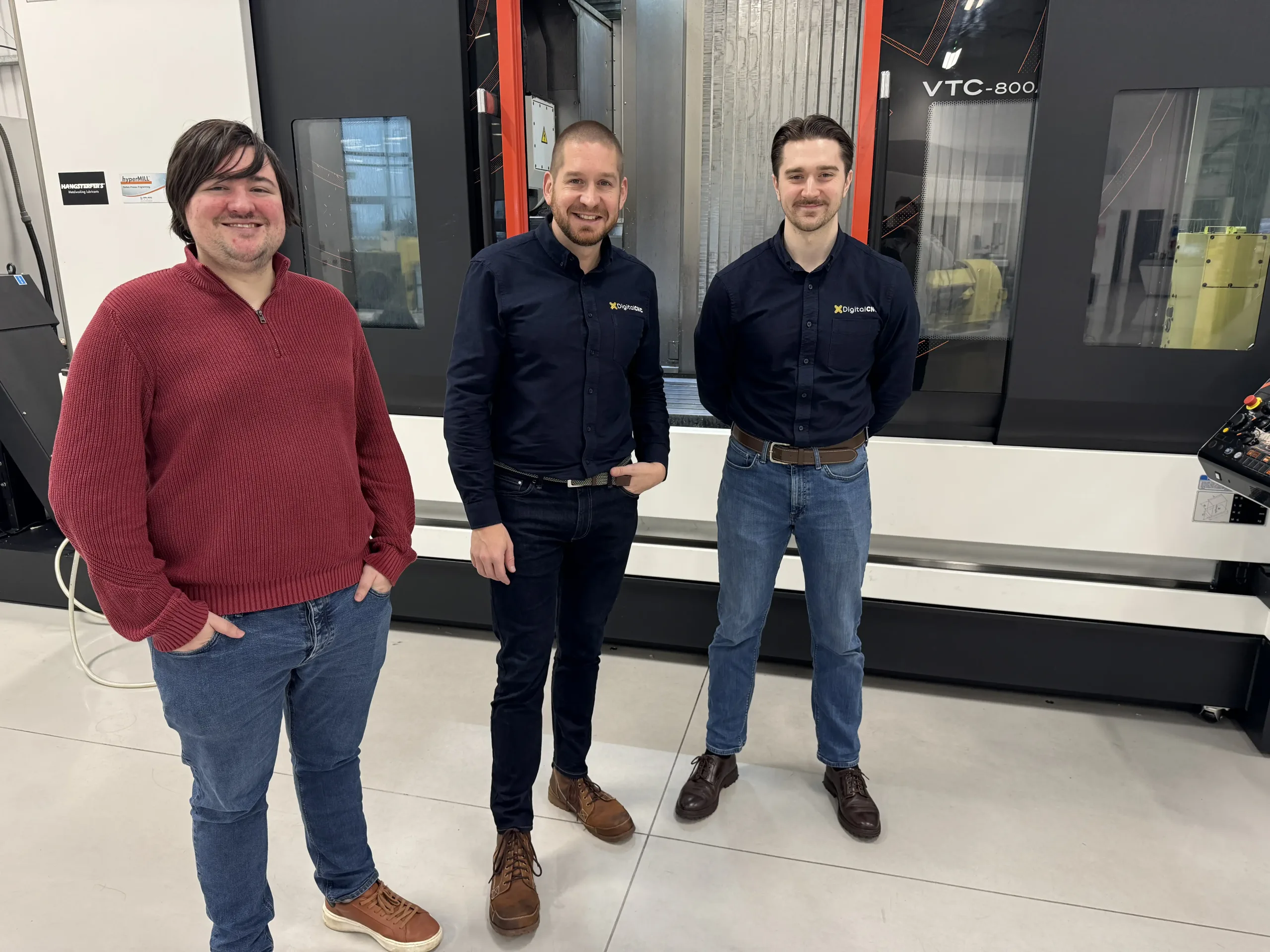
Pictured – Jake Rooms joins CEO Rob Ward and CTO David Wilkinson
We’re delighted to welcome three new software developers to DigitalCNC: Jake Rooms, who joins us as Senior Software Engineer, and Ben Brixton and Matthew Boyd, who begin their careers with us as Junior Developers.
Jake’s first few weeks included something you won’t find in a typical onboarding plan for software engineers: a visit to NIKKEN’s machining facility to see CNC operations up close. He wasn’t there to write code—he was there to experience the reality our software is built to predict, control and optimise.
There is no substitute for being on the shop floor: watching chips fall, hearing a spindle load change, seeing how real parts behave under real conditions, and speaking directly with the operators and CAM programmers who rely on our tools. These conversations reveal the truth behind every cycle time, every simulation, and every optimisation. They highlight where digital models succeed, where they fail, and where inaccuracies become costly.
We hired Jake for his experience in mathematics and software engineering—but that’s just the foundation. Now we’re investing in his development as an engineer, ensuring he understands not only the code we write but the manufacturing problems we’re solving. The same applies to Ben and Matthew. To build world-leading machining optimisation software, our developers need fluency in machining kinematics, control systems, and the physics of cutting. That knowledge shapes better thinking—and better tools.
At DigitalCNC, education isn’t a side activity; it’s central to who we are. Our technology originates from fundamental research at the University of Sheffield AMRC, combining advanced mathematics and machining science with AI and machine learning. That approach only works when our team understands both the theory and the industrial environment it’s built for.
Our software developers think like engineers—and that’s when our best work happens.