
Inside DigitalCNC: February 2026 Updates

Tech and Product Updates
February was a strong delivery month for DigitalCNC, with product improvements focused on customer success, accuracy and clearer communication. The updates in this release are designed to reduce friction in day-to-day use while strengthening the feedback loop between customers and our product teams.
Faster Issue Resolution
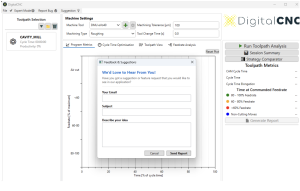
A key addition this month is in application bug reporting. Users can now report issues directly from within DigitalCNC, without leaving their workflow. This enables faster reporting with better technical context, allowing our support and engineering teams to diagnose and resolve issues more efficiently. For customers, this means fewer interruptions and greater confidence in day to day operations.
Customer Led Roadmap
We have also introduced in application feature suggestions, making it easier for customers to share ideas and feedback as they work. This ensures that user insight feeds directly into our roadmap and prioritisation decisions. By capturing feedback at the point of use, we are able to focus development effort on changes that deliver the greatest operational value.
Seamless CAM Integration
In addition, this release adds compatibility with Designcenter NX 2512, allowing DigitalCNC to be run directly from Designcenter. This improves integration with existing CAM environments and supports earlier validation of real machine behaviour, helping teams make informed decisions before cutting metal.
Together, these updates reinforce our commitment to building a product that combines technical accuracy with practical usability, shaped by the realities of modern CNC operations.
From the Founder’s Desk
Where CAM Meets Machine Reality
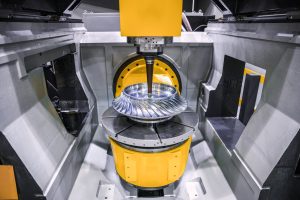
In his recent article, our founder, Dr. Rob Ward, examines why CAM predictions often fail to reflect real machine performance, using practical CNC examples to challenge common assumptions around machining strategy, cycle time and quality outcomes.
The articles explore:
-
Why continuous 5 axis machining can run slower than 3 plus 2 on real machines
-
How kinematic limits and controller behaviour impact feedrates and cycle times
-
The hidden quality risks caused by feedrate variation and machine dynamics
-
When simultaneous 5 axis machining is the right choice and when it is not
-
The real cost of trial and error when machining decisions are based on assumptions
Read more: Why 3 plus 2 Is Often Faster Than 5 Axis
Where Decisions Should Happen
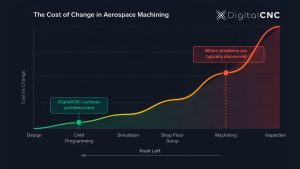
In this article, our founder examines why many of the most costly issues in aerospace machining are discovered too late in the process. Drawing on systems engineering principles and real manufacturing workflows, he explains how pushing critical insight upstream fundamentally changes the economics of machining decisions and reduces risk before production begins.
The article covers:
-
Why the cost of change increases sharply once machining reaches the shop floor
-
How gaps in information timing, not engineering capability, drive late stage failures
-
Why CAM programmers are forced to make high impact decisions without machine specific data
-
How upstream access to machine behaviour shifts decisions to when they are still affordable
-
Why early insight improves productivity, quality and risk management in aerospace programmes
Read more: What Can We Push Left? The Case for Upstream Data in Aerospace Machining
From Our Webinar Series
This month, we also hosted a webinar on aerospace machining, focused on dynamic milling strategies and real-world decision-making. The session was led by our CEO, Dr. Rob Ward and joined by Ryan Fletcher and Joe Berner from the Advanced Manufacturing Research Centre (AMRC), who shared practical insights from aerospace machining programmes.
The session explored:
-
Key challenges in designing toolpaths for aluminium and titanium aerostructures
-
The impact of machine kinematics, feedrates and toolpath selection on performance
-
A real aerospace case study showing how strategy choice affects cycle time and consistency
-
Why early access to accurate machine data improves decision making and reduces risk
-
How digital tools can be integrated into existing CAM workflows with minimal disruption

Watch the recording: High-Speed, High-Value: Mastering Adaptive Milling Strategies with DigitalCNC– Shared screen with speaker view
Passcode: !sxv6@mY
Beyond the office!
At a recent industry event hosted by Seco Tools, our CEO shared a clear view on the role of AI in manufacturing. The real opportunity is not AI in isolation, but AI grounded in a deep understanding of machining processes and validated against real data. Knowing what actually happens when metal is cut is what enables engineers to make better decisions earlier and with confidence. With organisations such as the Advanced Manufacturing Research Centre (AMRC) building this foundation, the challenge now is adoption and alignment across industry, investors and policy to turn world-class research into real commercial outcomes.

Photo courtesy: Seco Tools