Webinar Series · 2025–26
The digital path to aerospace and defence machining.
A four-part series with Dr Rob Ward and AMRC Machining Group experts. Each session takes a real precision machining problem — from foundational CAM challenges to 5-axis aerofoils — and works it through with Virtual Machining and DigitalCNC’s kinematic modelling.
The result: predictable cycle times, validated geometries, and confident decisions before the first chip is cut.
Webinar One · 20 November 2025 · 15:00 GMT
Conquering the Digital Gap.
Advanced CAM, Virtual Machining and DigitalCNC for precision machining.
Precision machining is defined by unforgiving materials, complex geometries, and non-negotiable quality demands. Even the most carefully programmed toolpath can fail on the shop floor due to the “delta between CAM and CNC” — the fundamental mismatch between the theoretical model and reality.
This introductory webinar breaks down the core CAM challenges in precision machining, defines the industry drivers pushing manufacturers toward digital solutions, and provides a foundational understanding of the modern digital toolbox required to guarantee part quality and minimise costly physical prove-outs.
Watch the recording
Questions about this session or the series? Email info@digitalcnc.ai.
See it for yourself — no install, no call, no commitment. Step through real interactive use cases and quantify the gap in machine hours, cost per part, and programme impact. Try the Virtual Environment >
Hosted by

Dr Rob Ward
CEO and Co-Founder, DigitalCNC
Guest speakers

Emily Pickford
Technical Fellow, AMRC

Rich Bonnell
Innovation Fellow, AMRC
Webinar Two · 12 February 2026 · 15:00 GMT
High-speed, high-value: mastering adaptive milling.
High-speed machining validation — when every second counts.
Adaptive milling has revolutionised roughing — maximising material removal rate while extending tool life on demanding materials like titanium and aluminium. But there’s a planning problem: predicting actual cycle times when adaptive toolpaths create constantly varying cutting conditions.
Dr Rob Ward and AMRC Machining Group experts dive into adaptive strategies and the industry’s biggest planning hurdle: the gap between programmed time and machine reality.
What you’ll learn
* How adaptive toolpaths optimise chip load and tool engagement for aggressive material removal
* Why conventional CAM time estimates fail with dynamic toolpaths
* Achieving accurate cycle time prediction through kinematic simulation and G-code analysis
* Virtual verification techniques to validate complex adaptive strategies before cutting
Watch the recording
Questions about this session or the series? Email info@digitalcnc.ai.
See it for yourself — no install, no call, no commitment. Step through real interactive use cases and quantify the gap in machine hours, cost per part, and programme impact. Try the Virtual Environment >.
Hosted by
Dr Rob Ward
CEO and Co-Founder, DigitalCNC
Guest speakers

Ryan Fletcher
Innovation Fellow, AMRC

Joseph Berner
Senior Project Engineer, AMRC
With the Aerostructures and Landing Gear Team, The Machining Group, AMRC.
Webinar Three · 9 April 2026 · 14:00 GMT
What your CAM software doesn’t tell you about 5-axis.
Why feedrate fluctuations create surface defects you only find at first-off — and how to predict them.
Feedrate fluctuations in simultaneous 5-axis create witness marks and surface defects — but CAM can’t show you where they’ll occur. The result: surface artefacts you don’t discover until the part comes off the machine.
The problem isn’t your CAM system or your machine. It’s the invisible gap between what CAM assumes and what your machine can actually deliver. This session shows how to close it — using machine-specific kinematic data to predict and prevent quality issues.
What you’ll learn
* Why feedrate variations in 5-axis show up as finish defects
* When 3+2 is faster than full simultaneous 5-axis
* Why vector programming needs machine-specific validation
* Identifying slowdown zones that create witness marks before cutting metal
* Testing strategies offline to negate feedrate-driven finish defects
Includes a real 5-axis aerofoil case study — pinpointing exact slowdown zones and surface defects in hours instead of days on the machine.
Who should attend
* CNC programmers laying down 5-axis toolpaths
* Production managers tired of surprised cycle times
* Quality engineers investigating surface defects
* Anyone transitioning from 3-axis to 5-axis machining
35-minute presentation + 10-minute Q&A — including demo and case study.
Watch the recording
Questions about this session or the series? Email info@digitalcnc.ai.
See it for yourself — no install, no call, no commitment. Step through real interactive use cases and quantify the gap in machine hours, cost per part, and programme impact. Try the Virtual Environment >
Hosted by
Dr Rob Ward
CEO and Co-Founder, DigitalCNC
Guest speakers
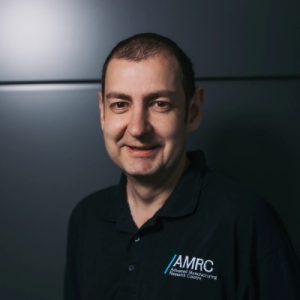
Dr Robert Carroll
Technical Fellow, AMRC

Bethany Cousins
Innovation Fellow, AMRC