Why Getting CAM Tolerance Wrong Ruins Your 5-Axis Surface Finish
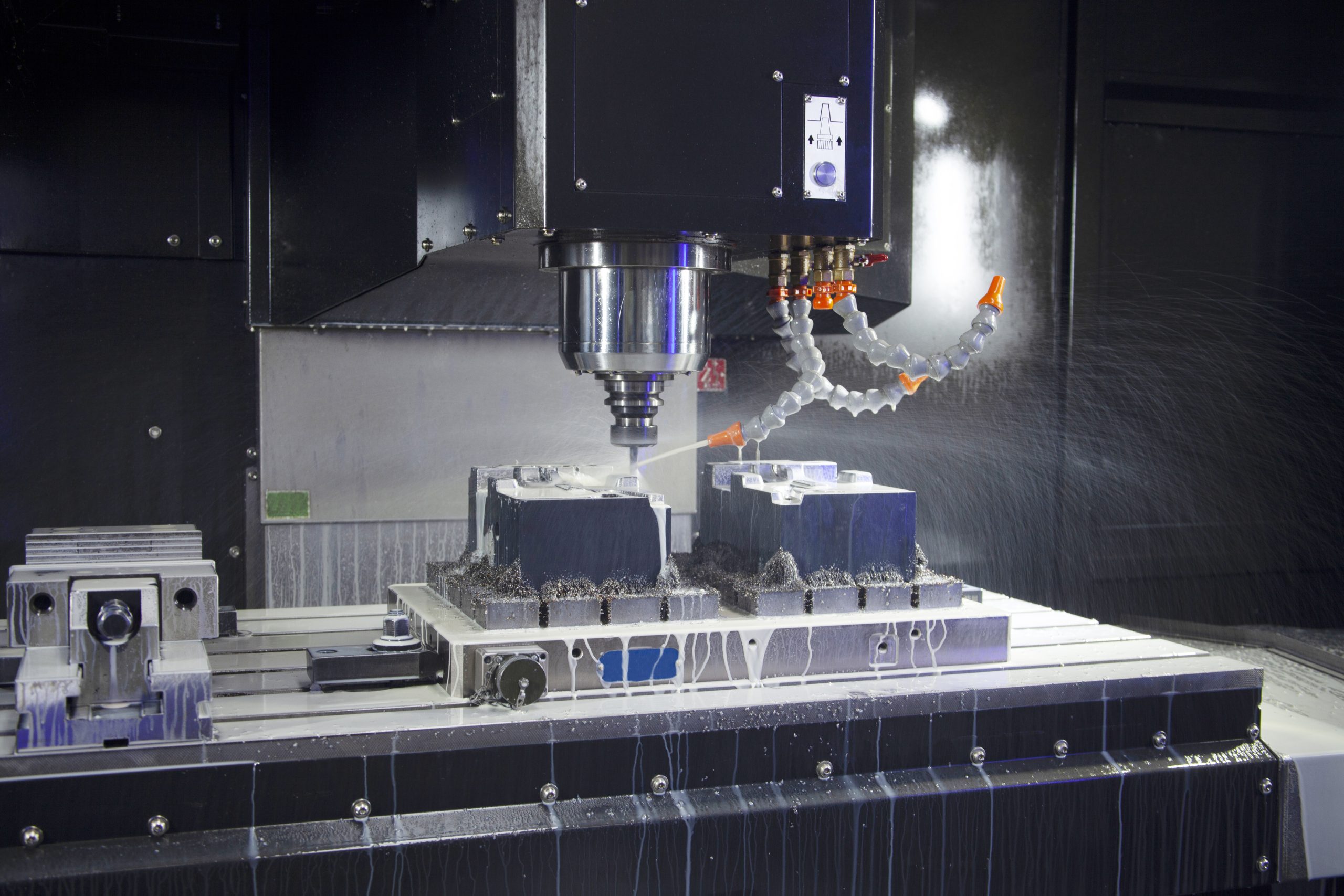
When a 5-axis finishing pass leaves witness marks on an aerospace component, the instinct is to look at the toolpath. Adjust the stepover. Add another pass. But in many cases, the problem was created long before the tool touched the part. It was created when the CAM tolerance was set, and critically, it was set without any knowledge of the machine that would actually run the code.
What the Tolerance Setting Actually Does
Every CAM system converts smooth CAD geometry into point-to-point linear segments. The tolerance setting controls how closely those segments approximate the original curve. Too loose, and the segments are large enough to leave visible geometric faceting on the surface. Too tight, and a different problem emerges.
On a modern high-performance 5-axis machine, the CNC reproduces every one of those linear segments exactly as programmed. Each segment ends in a direction change, forcing the axes to decelerate, change direction, and accelerate again. On the complex multi-axis moves that define 5-axis finishing passes, this happens continuously across the entire surface. Beyond a certain density of points, rather than improving surface quality, the toolpath creates witness lines, not from geometric error, but from the machine’s dynamic response to a continuous stream of micro-deceleration events.
These are two distinct problems with opposite remedies. Geometric faceting is solved by tightening tolerance. Controller throughput saturation is made worse by it. Setting tolerance correctly means finding the right balance for a specific part geometry on a specific machine.
Why This Is Specifically a 5-Axis Problem
In 5-axis simultaneous machining, the rotary axes sweep through arcs while the linear axes move at the same time. The tool tip trajectory is not simply the sum of those movements. The CNC has no information about the desired surface profile, only the axis positions it has been given. It cannot compensate for kinematic errors introduced as the rotary axes move between programmed points.
This means a toolpath that looks perfect in CAM simulation can still produce a surface that reflects how the machine moved between points, rather than the geometry the designer intended. Siemens’ guidance makes this explicit: chord tolerance must be set in the context of the machine’s dynamics. The tolerance value in CAM is not just a geometry decision. It is a machine-specific decision, being made without any data about the specific machine that will cut the part.
The Instinctive Fix Makes It Worse
When engineers see surface striations caused by controller throughput issues, the natural response is to tighten the tolerance further. More points, smaller segments. In this specific scenario, that is the wrong direction. Adding more points multiplies the direction changes. The constant acceleration and deceleration cycles now occur at higher frequency, programme files grow significantly, and the CNC spends more processing resource handling small blocks.
It is worth noting that all major CNC manufacturers have developed controller-side features to address this problem. FANUC’s Nano Smoothing, Siemens SINUMERIK’s COMPCAD, and Heidenhain’s Advanced Dynamic Prediction can all smooth dense linear toolpaths intelligently without sacrificing accuracy. These are standard features on modern high-end machines and should be understood and configured correctly as part of any 5-axis finishing strategy. However, enabling these features is not a substitute for selecting an appropriate tolerance in the first place. If the tolerance is poorly matched to the machine’s dynamics, you are relying on the controller to compensate for a decision that could have been made correctly upstream.
The Business Cost
Prove-outs on constrained 5-axis capacity run at several hundreds of pounds per hour. When surface quality issues emerge, the response is to iterate the toolpath, regenerate NC code, re-post, and run again. Each iteration consumes machine time that produces no saleable parts. Testing five different strategies on a one-hour process can cost £1,500 in machine time alone.
The deeper problem is that there is currently no reliable way to predict whether a tolerance setting will produce an acceptable surface before the machine runs. Prove-outs become the validation mechanism, and prove-outs are expensive.
DigitalCNC Solves This Before You Cut
The tolerance setting problem is a visibility problem. CAM engineers make decisions about how a toolpath will behave on a machine they cannot see from within their CAM environment.
DigitalCNC closes that gap. Working as a plugin inside CAM, it uses machine-specific kinematic data to predict actual feedrate behaviour across the surface in under a second. Engineers can see exactly where the controller will decelerate through a critical surface region, adjust the strategy in CAM, and re-analyse immediately, without touching the machine.
In a recent aerospace case study, CATIA predicted a 60-second cycle. The actual machine time was three and a half minutes. DigitalCNC predicted the real feedrate behaviour before cutting, the CAM strategy was adjusted, eliminating the need for multiple prove-outs and reducing engineering decision time from days to hours.
The right CAM tolerance is a part and machine-specific decision. DigitalCNC gives you the data to make it correctly, first time.
Join our webinar: What Your CAM Software Doesn’t Tell You About 5-Axis Machining. Wednesday 18th March, 15:00 GMT. Register here