Your CAM Program Is Perfect. So Why Is the Part Not?
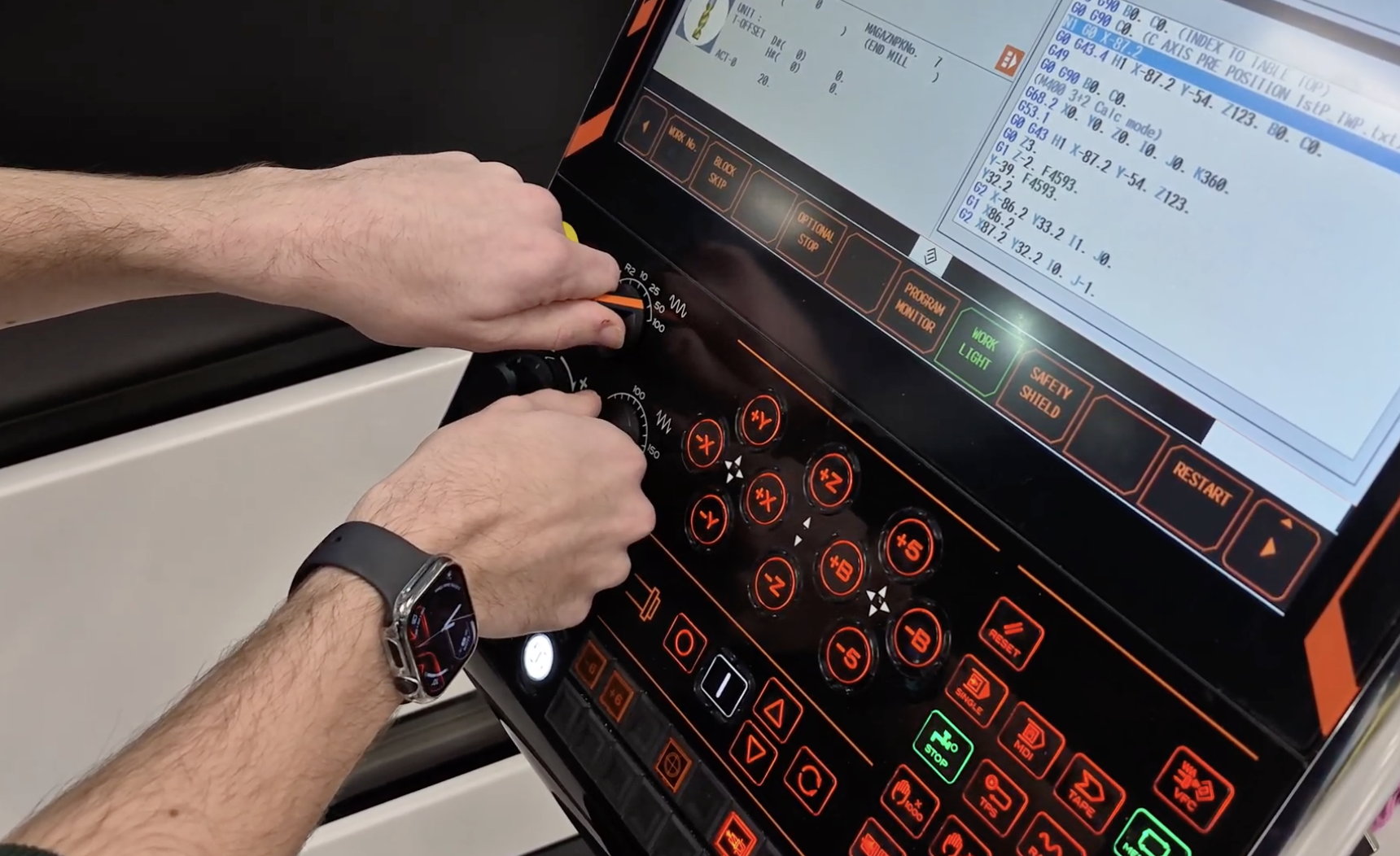
The part is on the inspection table. The program was correct. The simulation was clean. The toolpath looked exactly as it should. And yet there is a surface defect in the corner that was not supposed to be there. This is not a programming error. It is a physics problem that your CAM system cannot see.
WHY THIS PROBLEM EXISTS
When a CAM programmer sets a tolerance in their software, they are defining how closely the toolpath geometry should approximate the ideal part surface. What they are not defining is how the machine tool controller will interpret and execute that toolpath in practice.
The controller tolerance (CTOL) governs how the CNC interprets the stream of points and arc commands it receives. Where the CAM tolerance defines the shape of the toolpath on screen, the CTOL defines how faithfully the machine actually follows it. These two settings interact in ways that most CAM systems do not model, and that most programmers rarely have cause to examine directly.
The problem is compounded by machine kinematics. As the machine decelerates through tight corners, direction changes, or short segment sequences, the actual chip thickness delivered to the cutting edge drops significantly. In finishing operations, where tolerances are tight and surface quality is paramount, this deceleration can push chip thickness below the edge rounding of the tool itself, creating conditions for rubbing, work hardening, and possibly chatter rather than clean cutting.
CAM systems do not account for this by default because they have no understanding of the specific machine tool’s acceleration and deceleration behaviour through complex toolpaths. The toolpath looks correct in simulation because, geometrically, it is. The problem only becomes visible on the part.
WHY IT MATTERS IN PRACTICE
For general machining, a degree of surface variation is manageable. For aerospace components, it is not. Wing ribs, spars, and structural pockets are often manufactured to tight positional and surface tolerances, in materials that are sensitive to work hardening, and on features where rework is expensive or impossible.
The consequences of poorly understood tolerance interaction are not always dramatic. They often show up as: unexplained surface finish variation between nominally identical operations; chatter marks in deep pockets where tool extension is significant; premature tool wear that seems inconsistent with the programmed cutting conditions; and occasional scrap on high-value billets where the cause is difficult to diagnose confidently.
In deep pocketing conditions in particular, the compounding effects are severe. Cutter engagement spikes as the toolpath wraps around corners with no effective radial control. The machine decelerates through the corner. Chip thickness falls. With a long flute in contact, cutting forces rise sharply. In the worst cases, this produces chatter, surface defects, and spindle degradation on components where none of those outcomes are acceptable.
A 50% feed reduction in corners is a widely used CAM-level response to this problem. It helps, but as a blanket rule it does not account for the specific interaction of tool diameter, finishing stock, CAM tolerance output, and controller tolerance on a given machine. The result is a process that is partially compensated but not truly understood.
THE CONVENTIONAL APPROACH AND ITS LIMITS
The standard response to unpredictable surface finish in complex milling is conservative programming. Feed rates are reduced. Finishing stock is increased to give more margin. Corner feeds are halved as a rule of thumb. Trial cuts are run on representative material before committing to production.
Each of these measures costs something. Reduced feeds extend cycle times directly. Additional stock means additional finishing passes. Trial cuts consume machine hours and material. And even after all of this, the programmer is left with a process that has been de-risked rather than understood. If the surface finish is acceptable, they do not know how much margin they have. If it is not, they are adjusting parameters without a clear picture of which variable is responsible.
The deeper issue is that conservative programming optimises for avoiding failure rather than achieving the best possible outcome. On a high-value aerospace part, that distinction matters both in unit cost and in the confidence with which a process can be transferred, repeated, or quoted.
THE BETTER APPROACH
Tolerance-Aware Process Optimisation Using Real Machine Kinematics
The core of the approach is replacing assumed machine behaviour with modelled machine behaviour. Rather than accepting that the CAM simulation represents what will happen on the machine, the programmer works with a tool that understands the acceleration and deceleration behaviour of the specific machine, toolpath geometry and tolerance.
The starting point is the NC program as it will be sent to the machine. DigitalCNC ingests this directly and simulates execution against a model of the target machine tool, including its controller tolerance settings. The output is not a geometric verification but a kinematic one: what feedrate will the machine actually achieve at each point in the toolpath, and what does that mean for chip thickness at the cutting edge.
For finishing operations, the critical output is the feed per tooth map across the entire toolpath. Where chip thickness falls below the edge rounding value of the tool, the software identifies a risk of ploughing, work hardening, and chatter. The programmer can see exactly where on the part these conditions are likely to occur, and why.
This changes the decisions available to the programmer in several concrete ways. Tolerance settings, both CAM tolerance and CTOL, can be evaluated not just for their effect on cycle time but for their effect on cutting conditions. Corner strategies can be assessed against real deceleration behaviour rather than geometric approximations. Tool diameter selection for deep pockets can be informed by the actual wrap-around engagement the machine will deliver, not the idealised engagement the CAM system assumes.
The workflow change is significant but not disruptive. The programmer continues to work in their existing CAM environment. DigitalCNC operates as a plugin or parallel analysis tool, taking the NC output and returning a feedrate and chip thickness profile before the programme goes to the machine. Adjustments are made in CAM, reprocessed, and re-analysed until the achieved cutting conditions across the toolpath are within acceptable bounds.
What the programmer can now predict, and control is the actual chip thickness delivered at every point in the cut, on their specific machine, with their specific tolerance settings. That is the information that was previously only available after the cut had been made and the surface had been inspected.
PRACTICAL EXAMPLE
Deep pocket finishing in aluminium on a DST Ecospeed
Consider a deep pocket finishing operation on a structural aluminium component. The feature requires a long-reach tool, a tight CAM tolerance to maintain form accuracy, and a corner strategy to manage radial engagement around the pocket walls.
Using a conventional approach, the programmer programmes a 50% feed reduction in corners and runs the operation with a standard finishing tolerance. The surface finish in the straight sections is acceptable. In the corners, there is evidence of chatter and a visible surface defect that falls outside the inspection limit.
With DigitalCNC, the same NC program is analysed against the actual kinematic performance of the machine tool. The feed per tooth map shows that in the corners, the combination of machine deceleration and the tight CAM tolerance setting is producing chip thickness values below the edge rounding threshold of the tool. The 50% feed reduction has not been sufficient because the machine was already decelerating before the programmed feed change took effect.
The solution in this case involved adjusting the CAM tolerance distribution and the corner entry strategy, rather than simply reducing feed further. The re-analysed programme showed consistent chip thickness through the corner transitions. On the machine the cornering challenges were resolved without any increase in cycle time.
KEY TAKEAWAYS
- The tolerance settings in your CAM system and on your controller interact in ways that directly affect chip thickness and surface quality, particularly in corners and deep pockets. Understanding this interaction is not optional on high-value parts.
- A 50% corner feed reduction is a workaround, not a solution. It does not account for machine deceleration, controller tolerance behaviour, or the specific geometry of the feature being cut.
- By modelling the actual kinematic behaviour of your machine tool against your NC programme, it is possible to identify where chip thickness will fall below safe thresholds before the programme runs, and to adjust tolerance and strategy settings accordingly.
- The result is a finishing process that is genuinely understood rather than conservatively de-risked, with predictable surface quality, better tool life, and a reliable basis for process transfer and quotation.
If you have ever adjusted a corner feed, tightened a tolerance, or run a trial cut to chase a surface finish problem, the chances are you were solving the right problem with incomplete information. DigitalCNC gives you the information that was missing. See what your machine is actually doing with your toolpath before it touches the part.