
For CAM programmers and application engineers
Program for the machine you actually have.
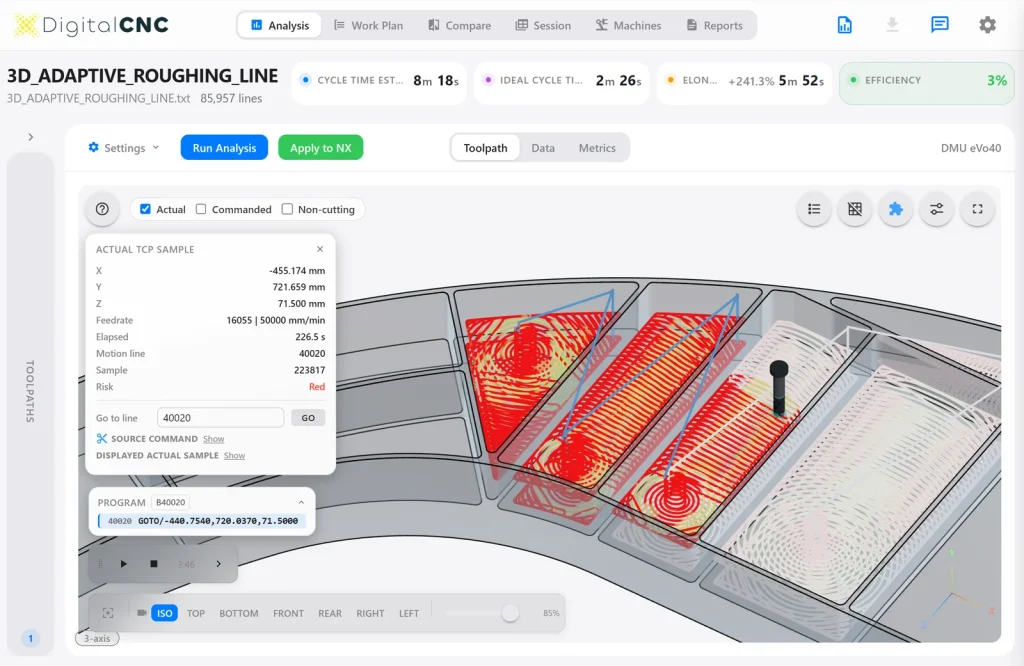
Better programs, less time proving them out, and more time for the complex work. DigitalCNC shows where every toolpath slows, where chip load drops out of range and where the tool is at risk, on your machine and controller, inside Siemens NX, Mastercam or CATIA V5. Adam proposes the fixes; you approve them.
Achieved feed · Chip load · Risk areas · Predicted cycle time
Better programs. More time for engineering.
Better programs
Chip load kept in range, slowdowns found and fixed before the program goes to the floor.
Optimised processes
Compare strategies, stepovers and feeds on your machine without using machine time.
Time recovered
Less time checking at your desk and proving out on the machine.
Skills that grow
Every recommendation comes with the reason, so you learn something on every job.
CAM defines the toolpath. It does not show how your machine will run it.
CAM works from programmed feeds. On the machine, kinematics, dynamic limits and controller behaviour often stop the programmed feed being reached, especially in corners, on short segments, through multi-axis moves and at tight machining tolerances.
When the feed is not reached, chip load leaves its designed range. That adds time, raises the risk of tool breakage and work hardening, and puts surface finish and tolerance at risk. CAM does not show any of it.
Better toolpaths, planned faster, with less risk.
Lower process risk
Keep chip load within its designed range and reduce the risk of tool breakage and non-conformance.
Shorter planning time
Fewer iterations to reach a toolpath that meets its time and quality targets.
Machine capacity recovered
Find where programs lose time to the machine’s own limits, and win it back.
Better estimating and scheduling
Quote, plan and choose machines on predicted run times for each specific machine, including parts never made before.
Engineers freed for engineering
Adam writes the method of manufacture from the CAM program.
Every improvement benchmarked, measured and documented.
Start by benchmarking the current process. DigitalCNC breaks each program down into time in cut and time out of cut, cost per part and output per hour, on the machine it will run on. Alternatives are tested in CAM before any machine time is used, and every change is documented with its before-and-after figures, so the improvement can be backed up, not just claimed.
Look beyond a single operation: see where time and cost go across a whole program or CAM session, and focus effort where it makes the biggest difference to the total cost of production.
Adam does the analysis. Your programmers make the decisions.
Adam (Autonomous Digital Agent for Machining) is an AI agent that controls DigitalCNC’s deterministic physics model: the same program on the same machine always gives the same answer. It runs analyses across whole CAM sessions, explains what limits each toolpath and proposes improvements based on cutting tool supplier data, machine tool builder recommendations and 25 years of advanced machining research. Every prediction comes from the physics. Every change is approved by the programmer.
Built on physics you can check.
DigitalCNC is deterministic: the same program on the same machine always gives the same answer, and every result can be traced back to the machine model. Developed and tested on Fanuc, Siemens, Heidenhain and Mazak controllers.
For one manufacturer, Adam produced a method of manufacture in 2 minutes. By hand it took a day.
Used by CAM programmers and application engineers at OEMs and tier ones across motorsport, medical, aerospace, defence, nuclear and heavy industry.
Where CAM theory meets the shop floor.
Technical articles, case studies and release notes from the DigitalCNC team, covering complex machining, cycle time reduction, and how to reduce process risk before cutting.

A Day in the Life of a CAM Programmer using DigitalCNC – CATIA on the Ecospeed
Three CATIA concentric strategies, one aluminium aerostructure bracket, and why the fastest option on paper is not the one you should run.

What’s New inside DigitalCNC (July & August 2026)
Both headline changes in this release close that gap. DigitalCNC now follows the job the way the controller does: across the whole sequence, and down through every call.

A Day in the Life of a CAM Programmer using DigitalCNC – Aerostructure Part in NX
Two roughing strategies on an aluminium bulkhead rib in Siemens NX, ranked by CAM and machine cycle times – with decisions being made at the desk, before hitting the machine.