
Machine-specific prediction for every toolpath.
DigitalCNC models your machine, your controller and your NC program, then predicts how each operation will run, move by move. Results appear inside your CAM system, before the program reaches the machine.
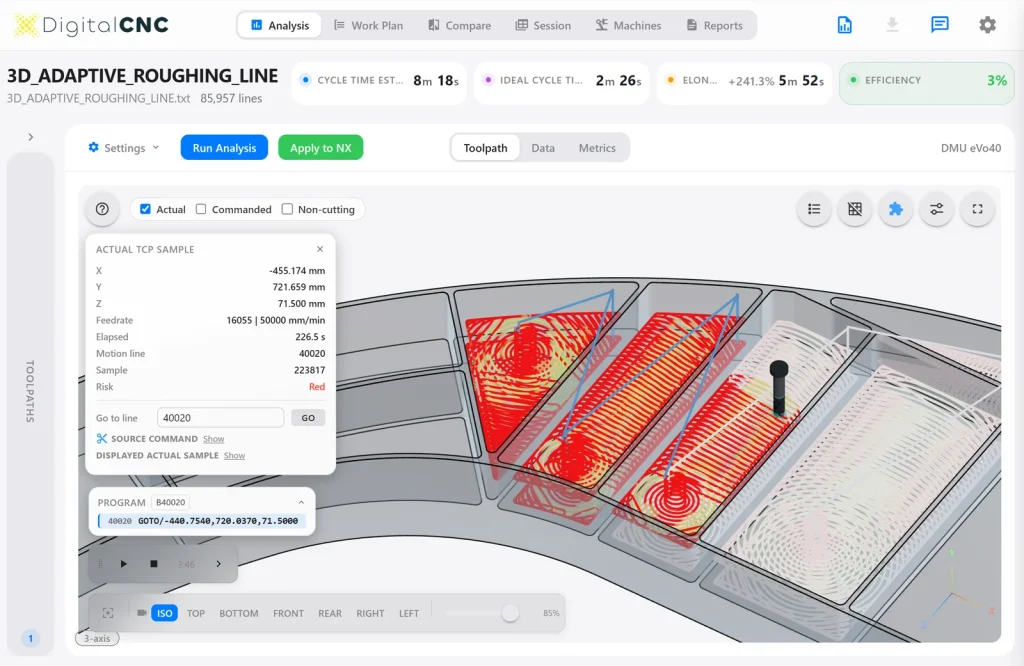
What DigitalCNC models
Your controller
Built from the controller archive file, including smoothing, compressor and look-ahead behaviour. Fanuc, Siemens, Heidenhain and Mazak.
Your machine
Kinematics and dynamic limits, including rotary axes and the inertia of large machines.
Your NC program
The machining tolerance set in the program header, which often has the largest single effect on cycle time.
What you see for each operation
Risk areas
Sections where chip load leaves its designed range, highlighted with the reason, for review.
Achieved feed
Commanded against achieved feedrate, and where the machine slows.
Predicted cycle time
For roughing, semi-finishing and finishing, each with its own tolerance.
Chip load
From an in-process workpiece simulation combined with the machine model, so it follows the machine’s predicted motion.
Capabilities
Chip load modelling
Keeps chip load within the tool supplier’s range, reducing the risk of breakage and work hardening.
Cutting parameter recommendations
Cutting data from tool suppliers, tooling databases and machine tool builder recommendations.
Closed-loop write-back
Approved changes written straight back to the operation in Siemens NX and Mastercam. In CATIA V5, changes are recommended for the programmer to apply.
Session analysis
Analyse 10 to 30 toolpaths from one CAM session in a single run.
Strategy and machine comparison
Compare strategies, or the same program on different machines, and cost the difference.
Automated reports
Before-and-after reports for every change, covering cycle time, cost per part and output per hour, plus method of manufacture documents generated from the CAM program.
Alongside verification software
Simulation confirms the toolpath is safe. DigitalCNC predicts how your specific machine will execute it.
